
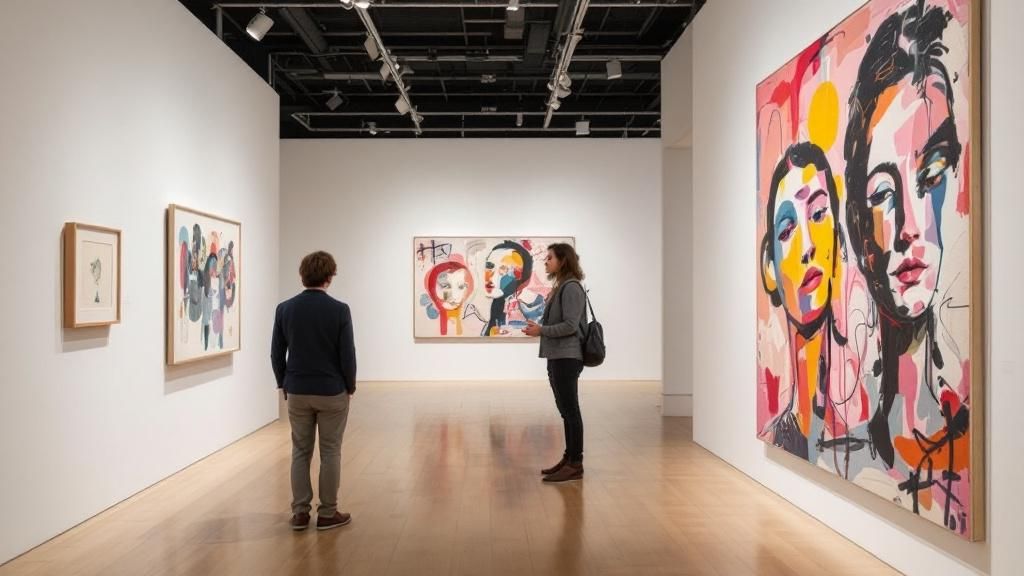
The Turner Prize has operated as a indicator of current creative innovation, and this year’s showcase proves no exception. By showcasing works that intentionally obscure the distinctions separating abstraction and representation, the exhibition organisers have crafted a stimulating provocation to viewers’ preconceptions about what art can communicate. This article investigates how the selected artists utilise non-traditional approaches and theoretical structures to challenge our comprehension of pictorial communication, ultimately questioning whether the traditional distinctions between abstract and representational art hold relevance in today’s creative landscape.
Redefining Theoretical Frameworks
The Turner Prize exhibition this year actively deconstructs traditional classifications that have historically shaped artistic discourse. By presenting works that fluidly move between abstraction and figuration, the curators challenge visitors to question their beliefs about the construction of visual meaning. The exhibition shows that today’s artists increasingly move away from binary categories, instead pursuing hybrid strategies that interrogate how we perceive and interpret visual information. This curatorial approach invites viewers to think more deeply with artistic purpose and aesthetic engagement.
These boundary-transcending works demonstrate a significant evolution within modern artistic practice towards conceptual fluidity and experiential ambiguity. Rather than adhering to rigid stylistic categories, the featured artists utilise techniques that intentionally undermine viewer expectations. The presentation shows that abstract and representational work are not entirely separate territories but rather points along a unified continuum. This reimagining encourages deeper contemplation about the way meaning develops through the relationship between artwork, viewer perception, and interpretive context, profoundly altering artistic conversation.
The Progression of Graphic Expression
Visual language has experienced profound evolution throughout the twentieth and twenty-first centuries, notably as artists grappled with photography’s challenge to representational painting. Modernist movements at first established abstraction as a fundamental shift from mimetic traditions, setting up ostensibly impassable conceptual divides. However, modern artists increasingly recognise these past distinctions as constructed boundaries. The exhibition demonstrates how visual language develops naturally, integrating multiple inspirations and methodologies that move past traditional categorical boundaries, expressing our ever more intricate visual culture.
Contemporary artists now integrate elements from abstraction, representation, and conceptual frameworks with remarkable complexity. This integrative approach recognises that visual communication operates through multiple interpretive pathways simultaneously. The Turner Prize exhibition showcases how artists employ tone, structure, arrangement, and symbolic reference to create complex significations that resist singular interpretation. This evolution demonstrates that creative vocabulary has matured beyond ideological rigidity, favouring instead a sophisticated lexicon capable of expressing the complexities inherent in modern life and perception.
Present-Day Interpretations
Modern artists approach abstraction with significantly varied theoretical foundations than their earlier counterparts, informed by postmodern thinking, digital contexts, and worldwide artistic practices. Rather than chasing abstraction in its purest form as an conceptual destination, contemporary practitioners treat abstract elements as means of expression within wider strategic frameworks. The show features pieces in which geometric forms, gestural marks, and colour interactions coexist with representational imagery and written elements. This multi-faceted approach reflects contemporary understanding that visual meaning arises from multifaceted exchanges rather than through single stylistic positions or aesthetic principles.
The chosen artists display remarkable facility in navigating diverse aesthetic modes at once, producing works that repay careful consideration and interpretive flexibility. Their work suggests that modern artistic practice increasingly functions as a dialogue between artist, artwork, and viewer, rather than as a one-way pronouncement. By incorporating varied aesthetic vocabularies, these artists acknowledge that the creation of meaning in modern cultural contexts requires sophisticated navigation of conflicting visual frameworks. The exhibition finally suggests that contemporary interpretation demands viewers relinquish rigid categorical thinking, adopting in its place the productive ambiguity that defines sophisticated artistic practice.
Critical Reception and Public Discourse
The exhibition has sparked substantial discussion amongst academic and critical circles, with responses spanning from wholehearted support to cautious doubt. Conservative voices have questioned whether the merging of abstract and figurative distinctions represents genuine innovation or just visual ambiguity. Conversely, forward-thinking commentators have praised the exhibition organisers for disrupting ossified categorisations that cease to capture current artistic approaches. This divergence of opinion demonstrates the exhibition’s role as a driver of substantive conversation within artistic circles and wider society.
Public engagement with the exhibition has gone beyond initial forecasts, attracting diverse audiences beyond the conventional gallery-going demographic. Social media commentary indicates that visitors are actively grappling with the works’ conceptual underpinnings, sharing interpretations and challenging one another’s perspectives. Museums have reported increased footfall and extended viewing times, suggesting that audiences are truly committed to deciphering the artists’ intentions. This grassroots enthusiasm demonstrates that contemporary art can resonate powerfully with the broader community when presented with sufficient contextual support and cognitive accessibility.
The exhibition’s impact reaches beyond direct assessment by critics, possibly shaping forthcoming curatorial practices and artistic direction across institutional structures. Emerging artists have pointed to the show as a turning point, affirming experimental practices that combine abstract and representational work. Educational institutions are beginning including the themes from the exhibition into their curricula, acknowledging its pedagogical value. As dialogue evolves to evolve, the Turner Prize exhibition appears positioned to occupy an important place in the history of contemporary art, transforming conversations regarding artistic classification and creative potential.
